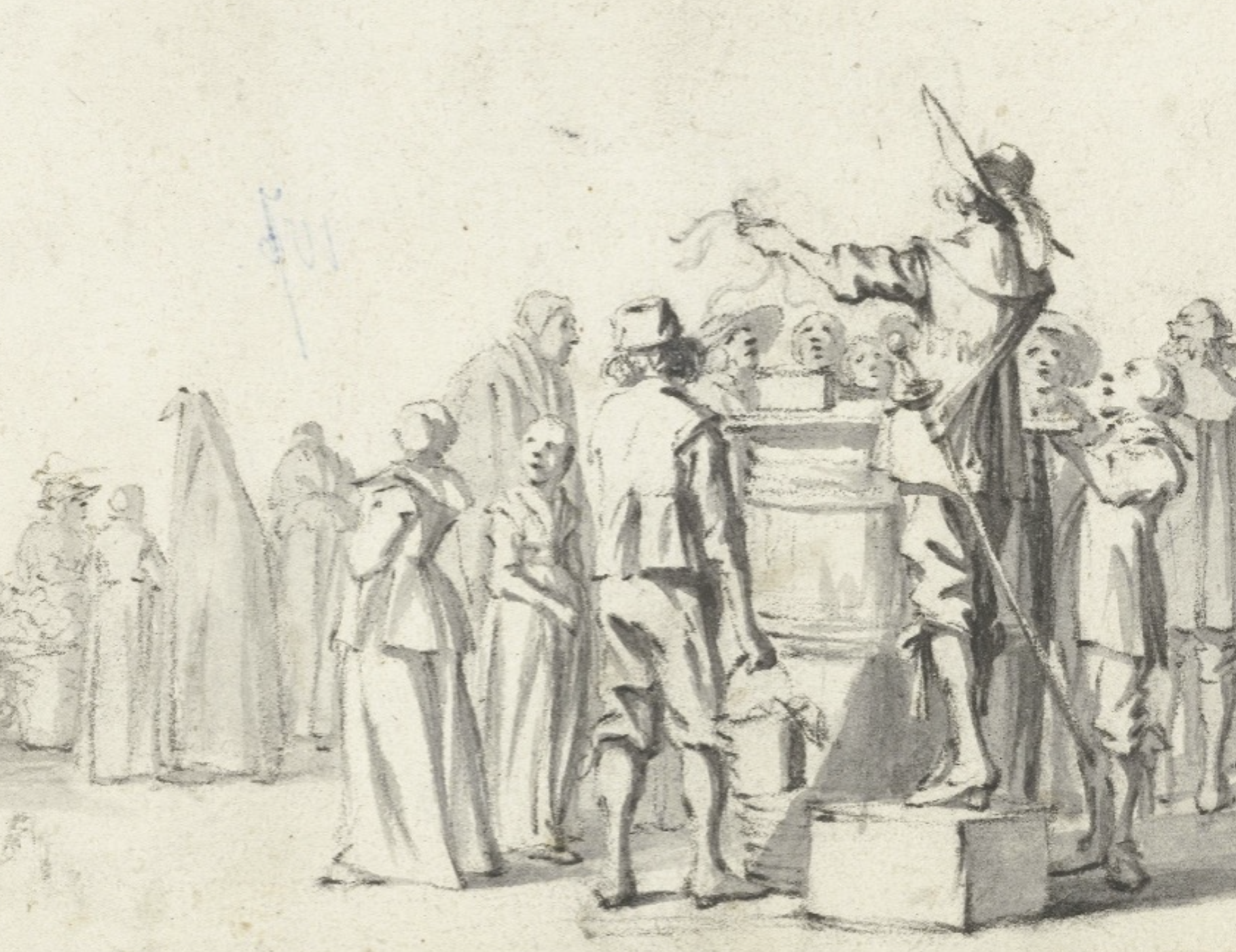
In this post, co-authors Christophe Gillain, Laura Incollingo, Arthur der Weduwen, Barnaby Cullen and Paweł Pietrowcew introduce their new article — ‘The Voice of the Law: The Town Crier as an Agent of State Communication in Early Modern Europe’ — published in Transactions of the Royal Historical Society.
Town criers were ubiquitous civic officials in early modern Europe. This article provides the first European-wide survey of the early modern town crier, drawing on archival evidence from across the continent.
It argues that the growing use of paper and print in this period did not diminish the importance of orality in state communication but in fact led to a greater reliance on criers by authorities.
Framing the town crier as a crucial actor in the process of state communication helps shed new light on the importance of orality in early modern legal and political cultures, and on the role of this urban professional in strengthening the bond between rulers and ruled.
This new article is now available, Open Access, in Transactions via CUP’s FirstView.
For most people, town criers call to mind the colourful and comedic purveyors of news seen at Renaissance fairs and village festivals rather than important representatives of government.
In historical scholarship, the medieval town crier has long been an established figure, though their role in later centuries remains more obscure. However, from the beginning of our work on the ‘Communicating the Law in Europe, 1500-1750’ (COMLAWEU) project [1], we knew that town criers were civic officials who played a fundamental part in how laws were communicated across early modern Europe, and that they were worthy of our attention.
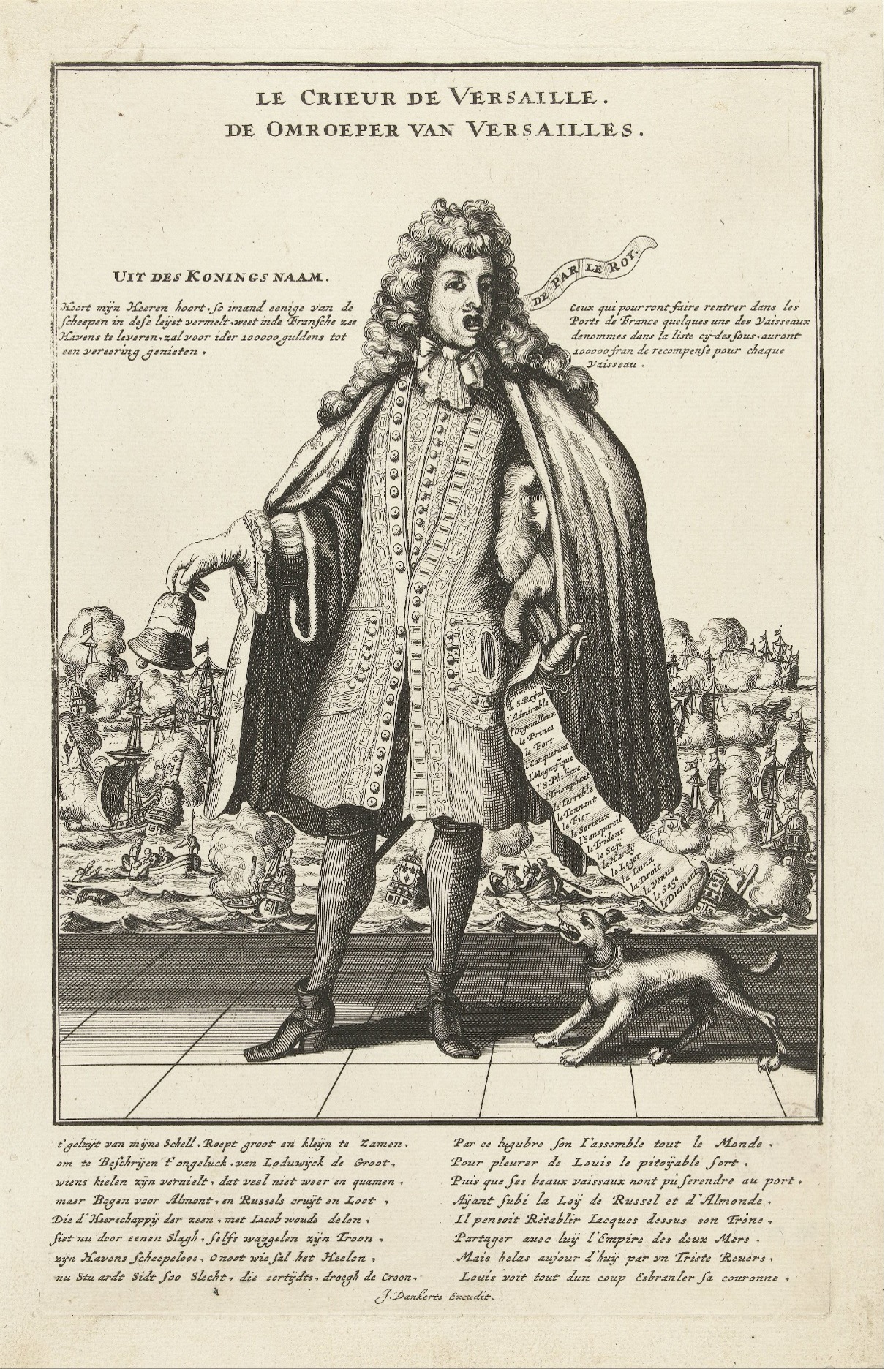
The satirical crier of Versailles. Joost Danckerts, Le Crieur de Versaille / De Omroeper van Versailles (1692). Rijksmuseum, Amsterdam: RP-P-OB-50.041
What none of us could have anticipated is the sheer extent and variety of sources related to town criers that we would find, especially in Italian, French, and Dutch archives.
We uncovered thousands of edicts and ordinances carrying printed or handwritten notices with details about their proclamation, payment slips in city council ledgers, contracts, and even newspaper advertisements; all contained valuable evidence about the activities and duties of criers.
Our new article — ‘The Voice of the Law: The Town Crier as an Agent of State Communication in Early Modern Europe’ — published in Transactions of the Royal Historical Society is a preliminary synthesis of these finds, offering the first European-wide survey of town criers as early modern agents of state communication.
Despite the wealth of information that we were able to gather, the major challenge we faced is that criers occupy something of a marginal position in the archives.
While we also conducted research in northern Germany, Sweden, and Poland, these efforts yielded much sparser evidence — in part, because town criers were used less frequently in these regions for the purposes of official communication. And where abundant material on criers does exist, in the vast majority of cases there is no archival collection or series specifically dedicated to them. Rather, traces of their activities, and their relationships with both the authorities and the public, are scattered throughout many different series and types of documents. Compounding these difficulties are major variations in the types of sources that we found across different institutions and countries.
The diversity of sources, combined with the limitations of archival cataloguing practices (which rarely describe documents at an item level), can make hunting for town criers and making sense of these finds seem like a daunting task … what we seek to do in our new article is to piece together this fragmentary archival source base to paint a portrait of an understudied civic official in early modern Europe.
How should we go about comparing the complete diary of a crier from Prato to newspaper advertisements mentioning criers from Haarlem? Even within the same city, there is often little consistency in the records that survive from different periods.
This diversity of sources, combined with the limitations of archival cataloguing practices (which rarely describe documents at an item level), can make hunting for town criers and making sense of these finds seem like a daunting task. Indeed, it would have been impossible to bring together evidence from over forty different archives across Europe if we were not fortunate enough to be working as a team of researchers with broad linguistic and geographical expertise. Seen this way, it is unsurprising that there has been no previous attempt to study early modern European town criers in a systematic fashion.
Nonetheless, what we seek to do in our new article is to piece together this fragmentary archival source base, along with the existing literature on town criers, to paint a portrait of an understudied civic official in early modern Europe.
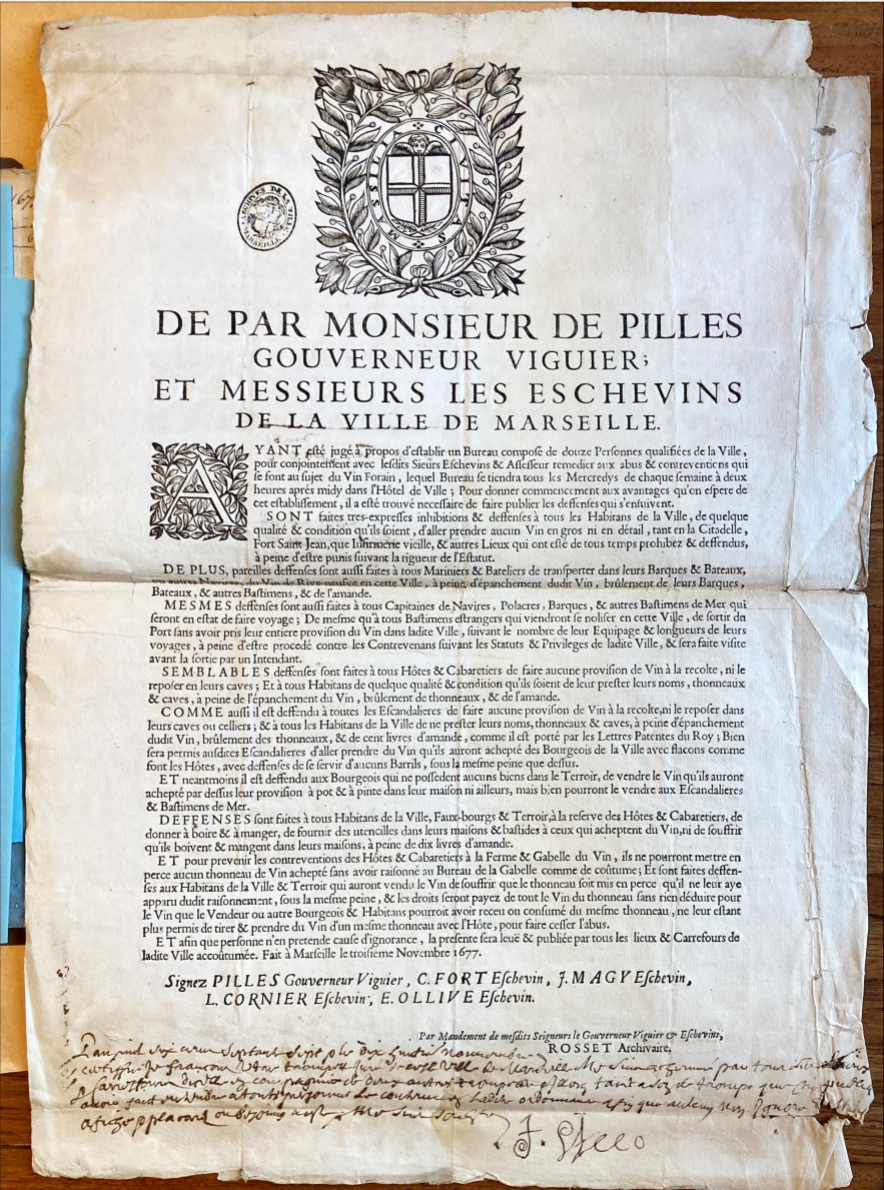
A 1677 Marseille placard on wine, featuring a handwritten note at the end confirming its proclamation by the town crier, following the printed exhortation noting that the regulation was to be ‘read and published at all the usual places and streets of the city’. Municipal Archives, Marseille: 1 BB.
Between the sixteenth and eighteenth centuries, a vast expansion in lawmaking and regulation led many political authorities to adopt print as a primary medium of communication. We aim to demonstrate that, far from replacing oral announcements, this growth in printed edicts and ordinances prompted the increasing use of town criers as well as greater regulation of their office.
Uniformed criers became an ever-more familiar sight in the streets of early modern towns and cities, accompanied by the sound of trumpets, drums, bells or cymbals. Moreover, once they had proclaimed a decree, criers were often charged with affixing printed placards of the text to reinforce their message.
Town criers occupied a crucial position as official mediators of information, embodying the ‘intermediality’ between orality, writing and print that characterised the early modern period.
What emerges from our analysis is that town criers occupied a crucial position as official mediators of information, embodying the ‘intermediality’ between orality, writing and print that characterised the early modern period.[2] The relevance of criers as political agents did not diminish over time, even if it was sometimes threatened by rivals who tried to make their own announcements or by discontented citizens who attacked criers as visible representatives of government authority.
We hope that this study can show the rich potential of a collaborative, comparative approach to the political, legal and urban cultures of early modern Europe. Although they are now largely forgotten, town criers during this period were ubiquitous figures who shaped the everyday lives of millions of people across the continent.
References
[1] COMLAWEU (Communicating the Law in Europe, 1500-1750) is an ERC-selected, UKRI-funded project based at the University of St Andrews (2024-2028).
[2] Daniel Bellingradt and Massimo Rospocher, ‘The Intermediality of Early Modern Communication: An Introduction’, Cheiron: Materiali e strumenti di aggiornamento storiografico, 2 (2021), 5-29.
About the Authors

Dr Christophe Gillain is a postdoctoral researcher with the COMLAWEU project at the University of St Andrews and a historian of early modern France.
He specialises in the histories of political communication, writing and mobility. He completed his PhD in History at the University of Cambridge and is currently working on his first monograph, titled Transnational Treason: Exile, Revolt, and the Making of Absolutism in Bourbon France, 1630-1661. Within the COMLAWEU project he investigates similarities and differences in how authorities communicated the law in France, including border regions like Provence and Flanders.
 Dr Laura Incollingo is a postdoctoral researcher with the COMLAWEU project at the University of St Andrews and a historian of early modern Italy and Spain.
Her first book, titled Political Engagement and Popular Print in Spanish Naples (1503-1707), was published by Brill in 2024. Her research interests cover the history of popular culture and popular print, as well as the study of information culture in Italy.
Within the COMLAWEU project, Laura’s research focuses on Italy, especially the cities of Florence, Bologna and Naples. She also looks at whether similarities and differences can be found in how the Spanish authorities communicated with their subjects in their various domains in Spain and Italy.

Dr Arthur der Weduwen is Reader in Modern History at the University of St Andrews and Co-Director and Project Manager of the Universal Short Title Catalogue, as well as Principal Investigator of the COMLAWEU project.
His publications, including seven books, eight co-edited volumes and more than forty articles and chapters, mostly concern the history of the Dutch Republic, and early modern communication, print culture, politics and law. His latest book is The Last Invasion of England: 1688 and the Dutch Armada (Princeton UP, 2026).

Dr Barnaby Cullen is a postdoctoral researcher with the COMLAWEU project at the University of St Andrews and a historian of the early modern Baltic Sea region.
He specialises in early modern Nordic book history, particularly the public sphere, news media, and the relationship between print and politics. He is currently working on a bibliography of Swedish- and Danish-language newspapers before 1700. Within the COMLAWEU project he focuses on the Baltic Sea region, most notably Sweden, Denmark-Norway, and their assorted territories, exploring how official information was disseminated across their linguistically and culturally diverse empires, and the impact of absolutism on this process.

Paweł Pietrowcew is a PhD student with the COMLAWEU project at the University of St Andrews and a historical demographer specialising in early modern Eastern Europe.
His research focuses particularly on how religious beliefs and ecclesiastical regulations shaped social, interfaith and sexual relations. Within the COMLAWEU project, he investigates the logistics of disseminating printed official publications in the Polish-Lithuanian Commonwealth.
Submitting an article to Transactions of the Royal Historical Society

Transactions is the flagship academic journal of the Royal Historical Society, published by Cambridge University Press. Today’s journal publishes a wide range of research articles and commentaries on historical approaches, practice and debate. In addition to traditional 10-12,000 word research articles, Transactions also welcomes shorter, innovative commentary articles. In 2023, we introduced ‘The Common Room’—a section of the journal dedicated to commentaries and think pieces by academic historians and historical practitioners.
The journal welcomes submissions dealing with any geographical area from the early middle ages to the very recent past. The journal’s co-editors and editorial boards are interested in articles that cover entirely new ground, thematically or methodologically, as well as those engaging critically on established themes in existing literatures.
From 2024, all articles accepted for publication in Transactions are published open access, without a charge for any author or reader. This ensures content published in Transactions can be shared, circulated and read by the widest possible readership. We very much hope this initiative will encourage a growing range of submissions from authors, worldwide, including those who practice history outside higher education, in related sectors or as independent researchers.
HEADER IMAGE: ‘A Dutch town crier holding forth to an attentive crowd. Gerard II ter Borch, Omroeper op een marktplein’, c. 1630–5 (detail). Rijksmuseum, Amsterdam: RP-T-1887-A-824
