How did early modern people remember and define rights of way in and beyond their communities?
Here, Dr Zoë Jackson reflects on a question which guides her postdoctoral research on how and why people in seventeenth- and eighteenth-century England and Scotland remembered, contested, and communicated their knowledge and use of these rights of way.
Her study draws on legal and family papers, and considers how social status and local history influenced debates over rights to access.
In this post, Zoë describes how the recent award of an RHS David Berry Fellowship in the History of Scotland and the Scottish People, for 2025-26, contributed to her research.
How did early modern people remember and define rights of way in and beyond their communities?
This is the question guiding a postdoctoral project I am developing on how and why people in seventeenth- and eighteenth-century England and Scotland remembered, contested, and communicated their knowledge of and use of these paths. I am particularly interested in how early modern people understood their legal right to use and access rights of way, and the different legal contexts in which these paths were experienced.
In 2025, I was awarded an RHS David Berry Fellowship which enabled me to make a one-week research trip to the National Records of Scotland (NRS), This was my first foray into early modern Scottish archival records for the project.
My doctoral thesis explored how people in later seventeenth-century England understood the relationship between perjury, or lying under oath, and memory.
This research was based heavily on legal records in both secular and church courts, at the local and central levels. I visited county record offices to review perjury cases, particularly in Quarter Session records, and instances of defamation for perjury in the consistory courts. I also reviewed records at The National Archives, sometimes to supplement research findings in the county archives, including Assize depositions, King’s Bench affidavits, and some Chancery pleadings and Star Chamber records. I was also already familiar with Exchequer depositions, which were central to my MPhil research.
I was able to identify and review a number of records referring to rights of way and disputes over access to them in various forms.
I was much less familiar with the kinds of records available in Scottish archives, so the NRS was crucial as an exploratory trip to understand what representations of rights of way I might find in Scottish records. I focused my research visit on the seventeenth- and eighteenth-century records in six series: three sets of Sheriff Court Records and three sets of family papers. In part thanks to sufficiently detailed descriptions in the online catalogue, I was able to identify and review a number of records referring to rights of way and disputes over access to them in various forms.
Although I had hoped to find detailed and well-documented legal disputes starting in the seventeenth century and lasting over decades, these disputes tended to concentrate in the eighteenth century.
Because part of my approach was to make use of family papers, the perspective on rights of way contained within them was overwhelmingly elite. This required me to think carefully about how to take account of the mediation of any statements and experiences of non-elite people who appear in the records. I drew insight from the rich engagement by historians and literary scholars on what we may glean from witness depositions and other legal records, I consider these statements both as reflections of what particular witnesses claimed to remember and which representations of pathways, and memory, were legible and acceptable to the courts and those participating in legal processes.
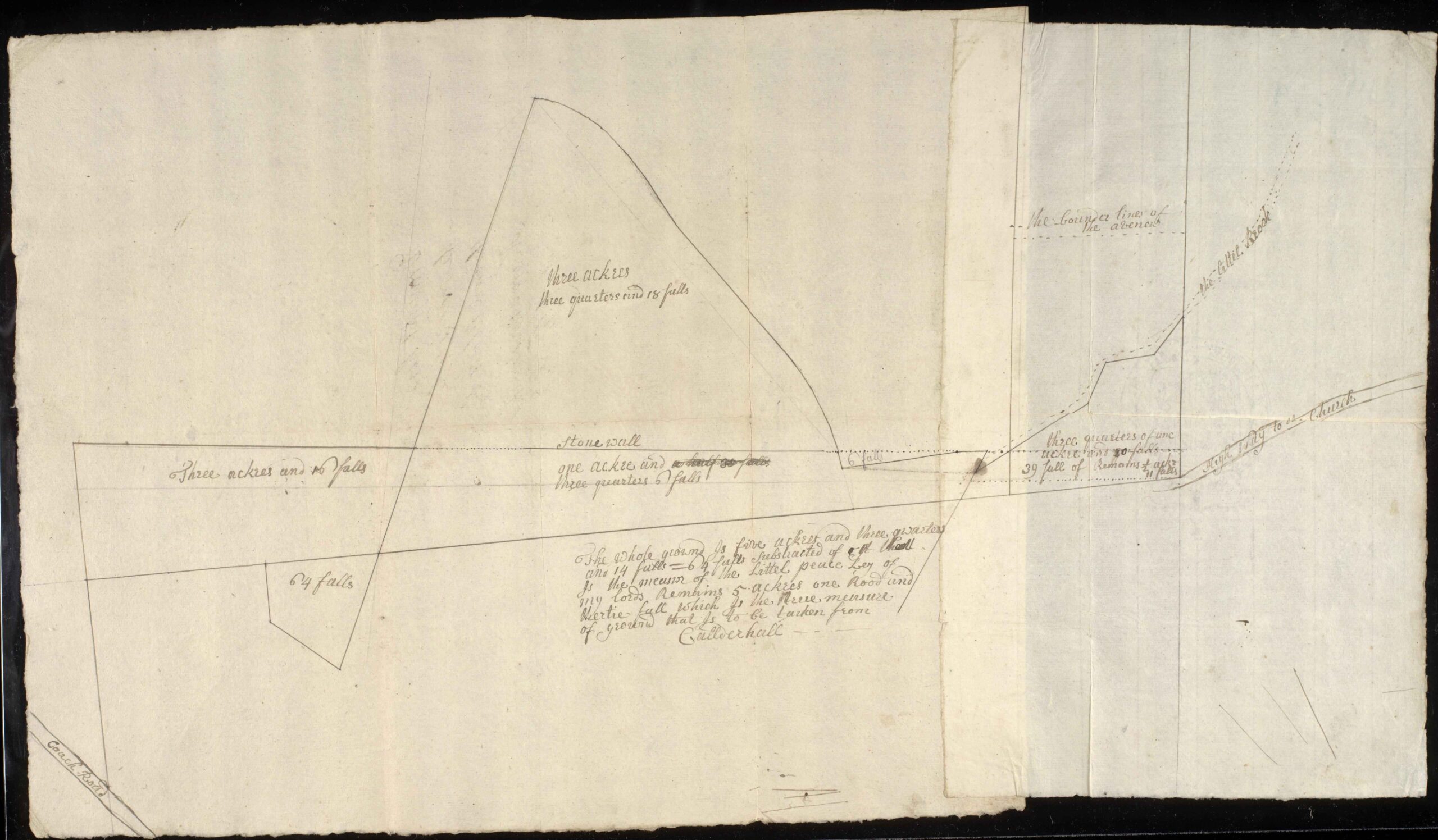
A plan produced as part of a dispute over a drove road (GD150/2335) © Crown copyright, National Records of Scotland, RHP20549 (cropped version of image accessed through the Scotland’s People website)
However, this research has also pushed me to think about my project in new ways, bringing my focus to specific themes I am eager to explore further.
Witnesses and litigants distinguished between various types of paths, pointing to both different purposes for using the routes as well as multiple reasons why these individuals believed they had the legal right to use them.
At a basic level, it has illuminated the different kinds of paths or rights of access that could be remembered and contested, and how they appeared in sources from both the seventeenth and eighteenth centuries. In the eighteenth-century litigation referenced above, one dispute concerned attempts to block or change a drove road through an estate in Kirknewton while another focused on an improper path through a churchyard in the Scottish Borders.[1]
Across the records, witnesses and litigants distinguished between various types of paths, pointing to different purposes for using the routes as well as multiple reasons why these individuals believed they had the legal right to use them. Knowledge and memories of the status of these paths were attributed to people across the social spectrum and featured in the extended litigation found in family papers, as well as in petitions, letters, and Sheriff Court records – sometimes as incidental mentions and elsewhere in lengthy detail.
My research at the NRS and in English archives has drawn my attention to other themes which I hope to explore in future work.
While the enclosure of certain pieces of land might be an underlying source of dispute over the pathways, it was seldom identified explicitly as the cause of conflict by witnesses who remembered the use of the paths by themselves or others. Rather, these witness statements tended to focus on more immediate interruptions to an ability to access the routes. To what extent did non-elite witnesses perceive the larger processes of enclosure as a key factor in changing access to such paths? And how did the understandings, experiences, and memories of these witnesses differ from the landowners attempting these changes?
Finally, this research has forced me to consider the long history of specific paths in dispute. The witnesses often attested to memories of using these routes over several decades. This, in addition to paths being a subject of litigation in the first place, points to their importance for these communities. If I were to look back in earlier records, would I find disputes over these same pathways, or suggestions over conflicts related to them?
I hope to develop this research in collaborations with civil society organisations to expand public understandings of rights of way.
My research trip to the National Records of Scotland has shaped how I imagine this project, and how I hope to continue to develop it. I plan first to write a journal article based on my NRS research, and then, if possible, to develop this research into the larger conceptualised project, which will ideally result in both an academic monograph and collaborations with civil society organisations to expand public understandings of rights of way. I am extremely grateful to the Royal Historical Society for providing me the opportunity to conduct this research.
REFERENCES
[1] National Records of Scotland (NRS), GD150/2335; NRS, GD40/5/48.
About the Author
Dr Zoë Jackson is an postdoctoral researcher. In 2024, she completed a PhD in Early Modern History at the University of Cambridge, researching the relationship between perjury and memory in later seventeenth-century England.
About the David Berry Fellowship
Launched in 2023, the David Berry Fellowship provides an annual award of up to £2,500 to undertake research on the history of Scotland and the Scottish people worldwide.
The David Berry Fellowship may be used to undertake research, and to cover the costs of research, into an aspect of the history of Scotland and / or the history of the Scottish people within the United Kingdom or worldwide.
The next call for applications is now open, with a closing date of 5 March 2027. Further details are available here.
