In this post, Iqbal Singh (The National Archives) and Eleanor Newbigin (SOAS, University of London) detail their recent one-day participatory workshop on colonial history for those working in higher education, the GLAM and creative sector and community-facing roles.
The workshop explored audio-zine making as a tool for thinking about historical sources and the construction of history itself.
The workshop took place in June 2026, thanks to support of an RHS Scouloudi Public History Grant. The audio-zine method invites participants to work collaboratively to build 2 to 3 minute tracks using layers of short recordings of actor-spoken text taken from official documents, alongside sound effects, ambient effects and music.
In June 2026, we hosted a one-day participatory workshop on colonial history at SOAS for people working in higher education, the GLAM and creative sector and community-facing roles to explore audio-zine making as a tool for thinking about historical sources and the construction of history itself. The workshop took place thanks to support from a RHS Public History Grants, funded by the Scouloudi Foundation.
The audio-zine method invites participants to work collaboratively to build 2-3 minute tracks using layers of short recordings of actor-spoken text taken from official documents, alongside sound effects, ambient effects and music. Engaging with the official archives aurally, rather than through the primacy of text, takes participants into psychological worlds that offer new affective tools to interpret archives which are fragmentary and require reading against the grain.
The approach centres multi-sensory engagement and a sense of ‘embodied playfulness’ in how we approach the past, in which the necessary tasks of interrogating documents and narratives allows participants to try out different text and sound options without prescribing a ‘right’ or ‘wrong’ way, that mirrors the idea of ‘play’.
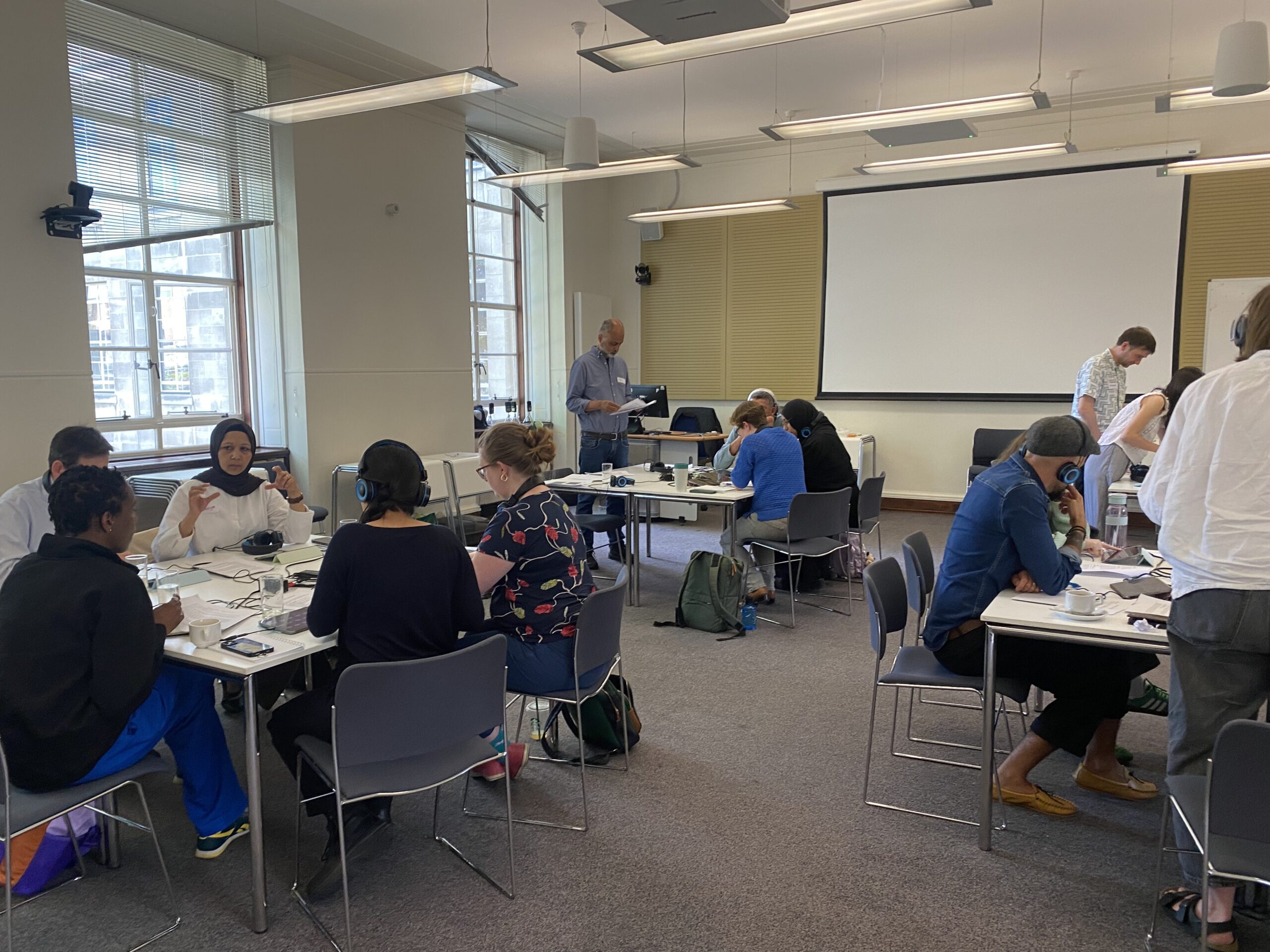
We began with introductions, each participant sharing their work and interest in using sound to critically explore colonial histories.
Iqbal and Eleanor explained how the audio-zine methodology had emerged through a decade-long collaboration with Fin Kennedy of Applied Stories exploring how audio could be used to produce new ways of engaging with the archive.
Tracing the evolution of this work from ‘factual’ audio dramas grounded in The National Archives (TNA) records towards more experimental work that moves beyond bringing records to life, Iqbal explained how the audio-zine methodology created space to think about the silences in the archive and the emotional economies running through these histories. Listening to a record on a zine sound deck elicits in the listener the idea of the archive as a space where records do not simply exist but are selected and their construction is arranged.
We set clear aims for the day, which were to connect and build a network of like-minded thinkers and practitioners from across the sectors we all represented, asking everyone to be mindful of this diversity and the expertise it brought. While scarce resources and funding were a shared concern, our aim was not to focus the day on future funding opportunities but to foster networks and ideas for the long term, leveraging our different skills both in the context of the days’ workshop and, we hoped, through future conversations and networking.

The programme had two parts. The morning centred on making an audio zine, using the Remixing History method developed by Iqbal, Elizabeth Haines, Fin and Farokh Soltani for their Global Second World War project. Teams of 4–5 participants worked around tables with four iPads: one held actor-voiced records centring the experiences of the war for those from South Asia and East Africa and included war office diaries, morale reports, propaganda and anticolonial literature ; the others held ambient sound, sound effects, and period or mood-setting music.
Sound engineer Farokh opened by describing his research on BBC radio drama, shaped by sitting in silent ‘audio’ archives that privileged written text over other ways of knowing. This workshop was, he explained, a creative, disruptive response to this kind of knowledge hierarchy, as he invited teams to respond critically to the archival material through layering, harmonising, or setting sounds in dissonance. Each group produced a 2–3 minute track, played live at the end of a 90-minute session.
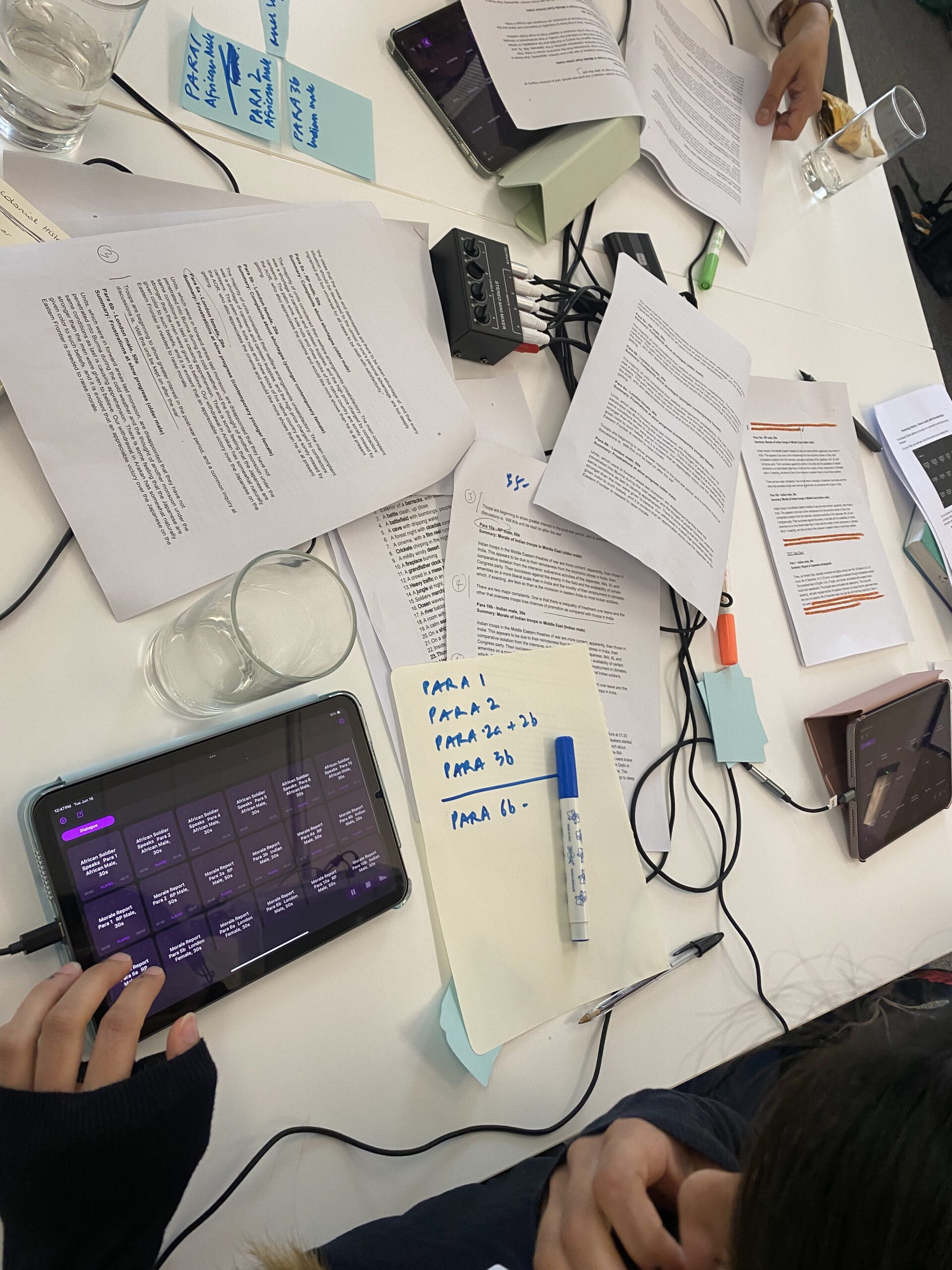
It was striking to watch groups of people who had only just met throw themselves into this creative task in a variety of ways; some started from text of the archival records, others went straight into listening to the extracts while working highly cooperatively. The groups produced four distinct tracks, even as they drew on many of the same extracts. This seemed to capture perfectly the wider mood of the morning, that working with difference rather than trying to smooth it over produced the most interesting, creative and critical ideas.
Lunch was followed by another highly participatory activity, using world café methodology. We set up four tables, each covered with paper tablecloth, a question at its centre surrounded by coloured pens, pencils and post-it notes. The questions invited reflections on what audio uniquely offers for engaging with difficult colonial histories; the structural obstacles, and possible through-routes, to critical work within GLAM, universities and the creative sector as non-neutral spaces; how collaboration might continue beyond the day; and how creative audio techniques might expand public engagement with British history.
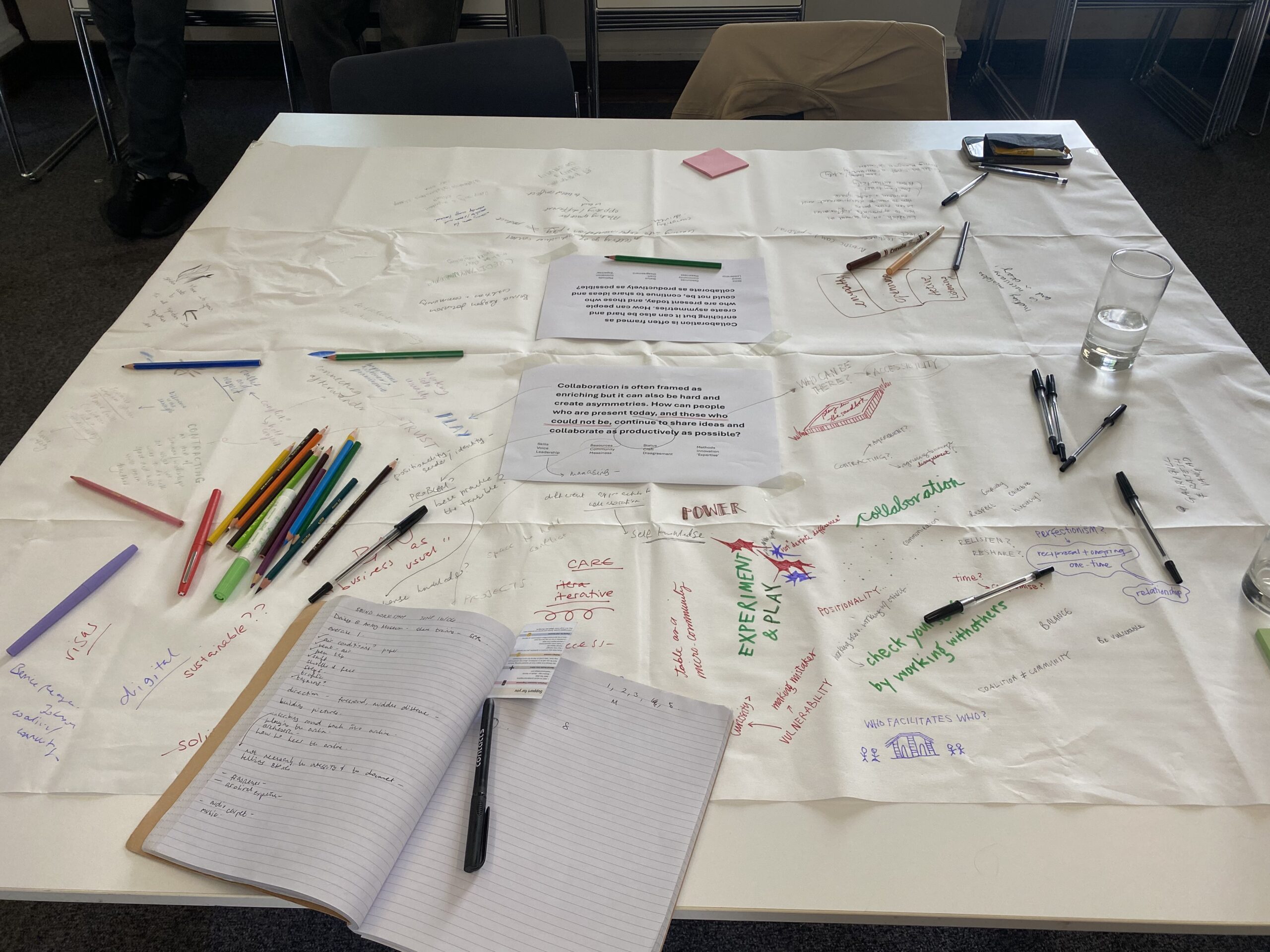
Participants rotated between tables at 15-minute intervals, aiming to speak with everyone in the room at least once. Workshop team members hosted each table, helping participants connect the current conversation to points raised by earlier groups, using the notes and visuals left on the tablecloth. A zoom recorder captured each of the four simultaneous discussions; we are now editing this audio into a ‘sound montage’ of the day’s conversations, alongside a range of other outputs.
People came away from the day better recognising how audio is very versatile as a medium and far more portable and less expensive than film. When audio is used in ways that allow people to work in teams to share and elaborate on the past it can take them away from singular and individual interpretations and offer benefits that can come from the power of the group.
Those taking part in the day recognised its extraordinary power to engage ‘communities’ collaboratively in reinterpreting the past in healthily disruptive and radical ways. As a methodology it is still in its very early stages of research, and reflections at the end of the day included discussing its great research potential. Finally, the day helped form a network that will be kept alive via pages on SOAS website that will include excerpts from the day, photos and other supporting materials.
About the authors
Eleanor Newbigin (SOAS, University of London) is a historian of imperialism and decolonisation in twentieth-century South Asia. Her work develops nuanced, critical understandings of the end of formal colonialism in South Asia through rigorous archival research.
Iqbal Singh (National Archives) is Regional Community Partnerships Manager at the National Archives. He leads a pioneering practice-based research programme exploring with diasporic communities in the UK, complex and nuanced readings of Britain’s colonial and imperial past.
About the RHS Scouloudi Public History Grants

Scouloudi Public History Grants support innovative practice in public history and provide funding for defined projects by historians working together in and beyond higher education.
Launched in 2025, this programme is generously supported by the Scouloudi Foundation.
