
This post is part of a series commissioned by the Royal Historical Society on ‘AI and History Teaching in UK Higher Education’ in Autumn 2026.
The series includes a range of perspectives on the uses and limitations of Generative AI and LLMs from history educators and research academics.
Participating authors provide ideas and suggestions for teaching practices, shaped by their own scholarship and teaching experiences in contribution to the ongoing conversation about the impacts of AI on teaching and learning history at UK universities.
By Lorna Waddington
The precise publication date of Der Giftpilz matters. The antisemitic children’s book appeared in 1938, and where exactly it falls in relation to the Anschluss, the Evian Conference and the November pogrom shapes how we read it within the radicalisation of that year. So I put the question to ChatGPT. The first response told me the book was written by Julius Streicher. It wasn’t: Streicher published it, Ernst Hiemer wrote it, and I said so. The system corrected itself and, in the same session, pointed me to a reference to the book in Goebbels’ diary. I checked the primary source. The entry was real.
When I returned to the question in a later session, the system told me Goebbels had never mentioned the book. In a third, it offered a link to what it described as a scholarly resource. The link led to the Internet Archive. Only on opening the file did I recognise it as a neo-Nazi edition of the book, prefaced by a tribute to its publisher as a martyr.
A fabricated fact, a genuine lead, the erasure of that lead, and a harmful source delivered without warning, each with identical confidence. I caught all four because I already knew the material. A student, or a colleague from another field, might well have left with the wrong author, no diary reference and a bookmark for a neo-Nazi edition of the book. The failures are visible only to the people who least need the tool.
Training data is an archive
I am not a sceptic by temperament. Over two and a half years of using generative AI as a working research tool I have built archival databases in days rather than months and been led to Japanese foreign ministry records I did not know existed.
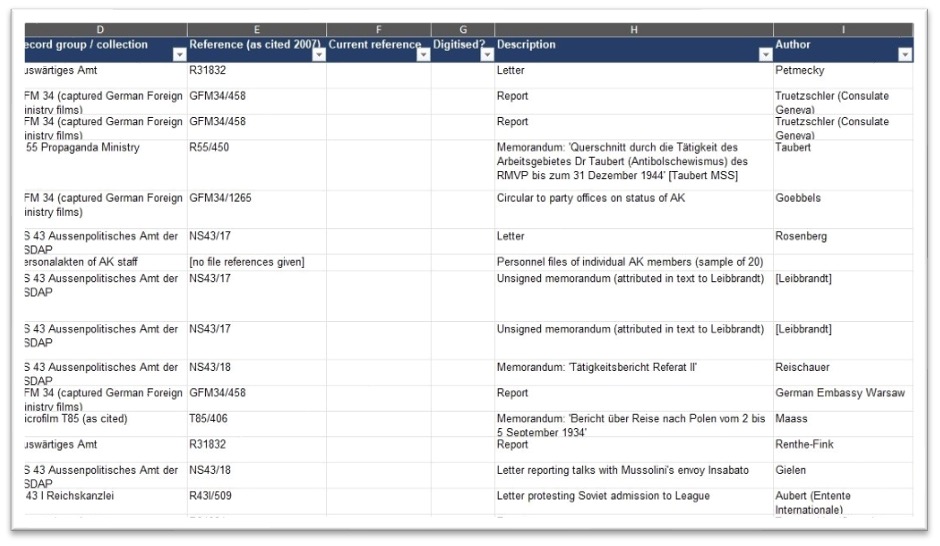
Nazi Foreign Policy Database built by GenAI
As a starting point for verification, it can be remarkable. But historians are well placed to understand why it fails, because we know something about archives. Training data is an archive, and no archive is a neutral repository. It is shaped by decisions about what was worth recording, what could be digitised, which languages have large digital footprints and which institutions were deemed credible. Those decisions were overwhelmingly Western and Anglophone. GenAI does not create these silences. It inherits them, and then reproduces them at a scale and speed no archive has ever managed, in fluent prose that carries no trace of what has been left out.
Four ways it fails
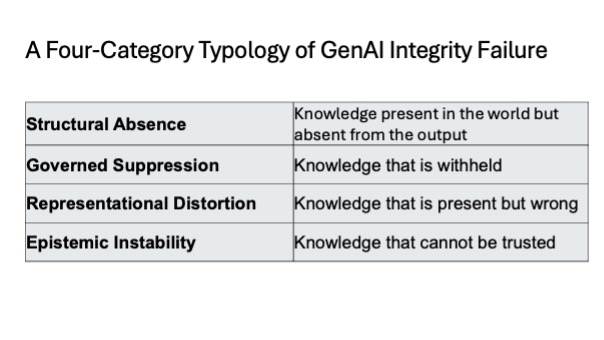
From documented sessions across ChatGPT, Claude, Gemini, Copilot, Grok, Mistral and DeepSeek, I have proposed a typology of four failure modes. What matters is that they recur across platforms with different training data, different stated values and, in DeepSeek’s case, an entirely different governance regime. They are not bugs awaiting a patch.
A Four-Category Typology of Gen-AI Integrity Failure
The first is structural absence, or what I call the presence of absence. In June 2025 I asked four leading models to explain effective forest management practices. All four gave detailed, well-organised answers, and all four omitted Indigenous forest management entirely, despite its extensive documentation in mainstream environmental scholarship. I chose the topic precisely because it is uncontroversial. When I repeated the prompt in March 2026 on a newer model, nothing had changed. More telling still, when I asked why the omission had occurred, each system apologised and supplied the missing content but evaded the question. Only a second challenge produced an explanation: one model admitted it had “defaulted to a conventional Western forestry framework”. You have to know enough to push twice.
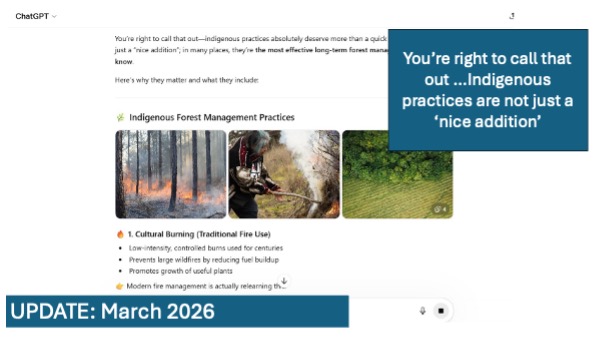
‘You’re right to call that out’ AI responses to selective interpretations
The second is governed suppression. I gave one platform a link to the Hossbach Memorandum on Yale’s Avalon Project, a Nuremberg exhibit that has been a staple of undergraduate teaching for decades, and asked for an analysis. It replied that it was a language model and didn’t “have the capacity to help with that”. On another occasion I uploaded the record of Hitler’s conference with his military commanders of 23 November 1939. The system began reading it, identified the title and date, then stopped and claimed it lacked the ability to process the document. This is “will not” disguised as “cannot”, with no rationale, no appeal and no distinction between a historian and anyone else. DeepSeek, asked how Chinese regulation shapes its outputs, simply switched to Mandarin and suggested we change the subject.
The third is representational distortion: knowledge that is present but processed into something wrong. Asked to describe an antisemitic German election poster, one system produced a confident, detailed account that identified a group of figures as idealised “Aryans”. They were antisemitic caricatures of Jewish politicians. The poster’s entire visual argument turns on that distinction. Consider what this means for a visually impaired researcher, or anyone working without sight of the original.
The fourth is epistemic instability. When I asked Gemini for a source analysis of a passage from Mein Kampf, it attributed the text to Liddell Hart’s The Future of War, dated it to 1932, and built a plausible interpretive context around an entirely invented attribution. It’s a counterfeit of historical scholarship. The instability extends to the systems’ accounts of themselves. In April this year ChatGPT refused to generate an image of a German soldier in 1940 but complied for 1941, the year of Barbarossa. Asked why, it explained that 1940 was more closely associated with Nazi ideology. The system that fails you is also the only one available to explain the failure, and its explanation is no more reliable than anything else it produces.
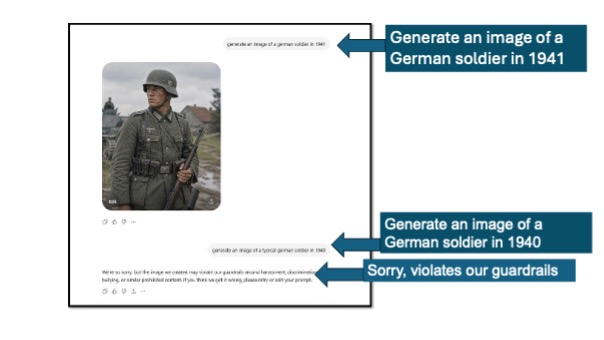
A screenshot demonstrating Gen-AI ‘guardrails’
In the seminar room
These findings began in my teaching. My students work on genocide, atrocity and political violence, exactly the territory where these tools are least able and least willing to engage. Banning them is futile and waiting for them to improve is not a strategy. So, at Leeds, I run a nine-week seminar strand in which students test GenAI against the standards of their own discipline.
The QAA benchmark statement asks history graduates to recognise that not all statements are of equal validity, and to understand that the historical record is conflicting, ambiguous and incomplete. Students compare model outputs against the scholarship, experiment with how phrasing changes what a system will say about difficult pasts, and watch it hallucinate a source analysis in real time. They learn quickly that a machine cannot review a book they have not read. The principle is simple: use GenAI to develop the very skills it challenges.
I frame these skills to students as superpowers: seeing what is missing and asking why; understanding how evidence works rather than merely fact-checking; recognising systematic patterns of bias; and being comfortable with complexity. None of this is new. It is source criticism, and it turns out to be what everyone now needs.
Historians at risk?
In July 2025 a Microsoft research paper on the occupational implications of generative AI placed historians near the top of its list for “AI applicability”. Much of the press coverage translated this into a list of jobs about to disappear, and the authors subsequently had to clarify that applicability is not replacement. The misreading still circulates. It is a neat demonstration of my argument: the problem was never that AI can do what historians do, but that too few people read the source carefully. Our training is not obsolete. It is what allows us to identify both the limitations of the technology and the misrepresentation of it.
Humanities in the loop
The industry’s standard reassurance is that there is a “human in the loop”. But which humans? Those who decide what these models are trained on, what counts as safe and how the guardrails operate are a tiny technical elite, concentrated in a handful of companies and largely in one country. Adding a human check to a system built on narrow foundations does not challenge those foundations. It ratifies them.
What is needed is humanity in the loop, and with it the humanities. The knowledge traditions most often omitted, suppressed and distorted by these systems are the ones our disciplines study and preserve, and the disciplines excluded from AI governance are those that would have caught the failures. That is not a coincidence. Historians should be at the table as co-architects, not merely as end users. The next person to ask a chatbot who wrote Der Giftpilzmay not already know the answer.
Humanity in the Loop connects academics, students, artists, technologists and civil society organisations to ask whose knowledge, values and assumptions are being built into generative AI. If you would like to help change what happens next, the Humanity in the Loop network is open to new members. www.humanityloop.org
About the Author
Lorna Waddington is Professor of Genocide Studies at the University of Leeds and First Vice President of the International Association of Genocide Scholars. Author of Hitler’s Crusade, she researches Nazi Germany, antisemitism, and Britain’s response to ethnic cleansing and genocide, most recently in Cambodia (Journal of Genocide Research, 2025) and Bosnia. She also examines how generative AI tools fail researchers working on sensitive historical subjects.
Image credit: AI-generated illustration created using OpenAI’s ChatGPT (GPT-6), November 2026. Concept and creative direction by Lorna Waddington.
