This post is part of a series commissioned by the Royal Historical Society on ‘AI and History Teaching in UK Higher Education’ in Autumn 2026.
The series includes a range of perspectives on the uses and limitations of Generative AI and LLMs from history educators and research academics.
Participating authors provide ideas and suggestions for teaching practices shaped by their own scholarship and teaching experiences in contribution to the ongoing conversation about the impacts of AI on teaching and learning history at UK universities.
By Dr Jesús Sanjurjo
For the past year, I have spent part of almost every working day reading nineteenth-century prison records with an artificial intelligence model.
The logbooks belong to the Real Cárcel de La Habana, the royal prison of colonial Havana. They are being digitised through the British Library’s Endangered Archives Programme, in a project led by the University of Strathclyde with the National Archive of Cuba and the universities of Glasgow and Havana, and supported by the UK Economic and Social Research Council, the Spanish Government and the Hispanic Society of Scotland. My colleagues Lloyd Belton (University of Glasgow), Yaimara Izaguirre (University of Havana), Yashar Moshfeghi (University of Strathclyde) and I lead the project, which we call ‘The Prison Blueprint’.
The model reads the notarial hand quickly and, for the most part, accurately. Yet the most instructive thing it has taught me has nothing to do with speed or fluency. When the machine fails, it fails silently. Its characteristic error is not invention but omission: a marginal annotation, a second offence, the brief line recording a prisoner’s death. An invented detail (a hallucination, as they are often referred to) announces itself to anyone who checks. An omission is invisible unless someone goes looking. That finding now shapes how I think about teaching history.
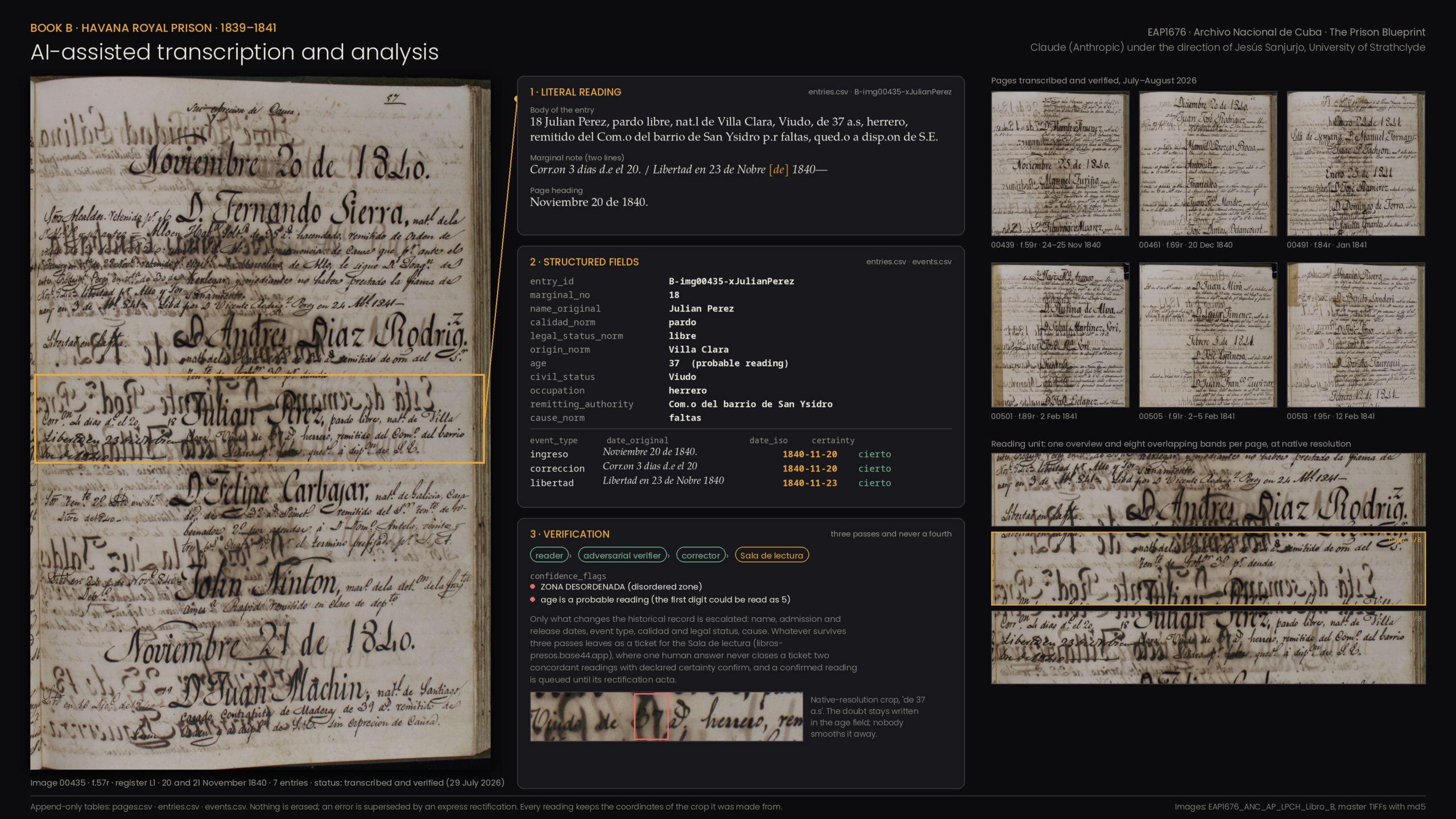
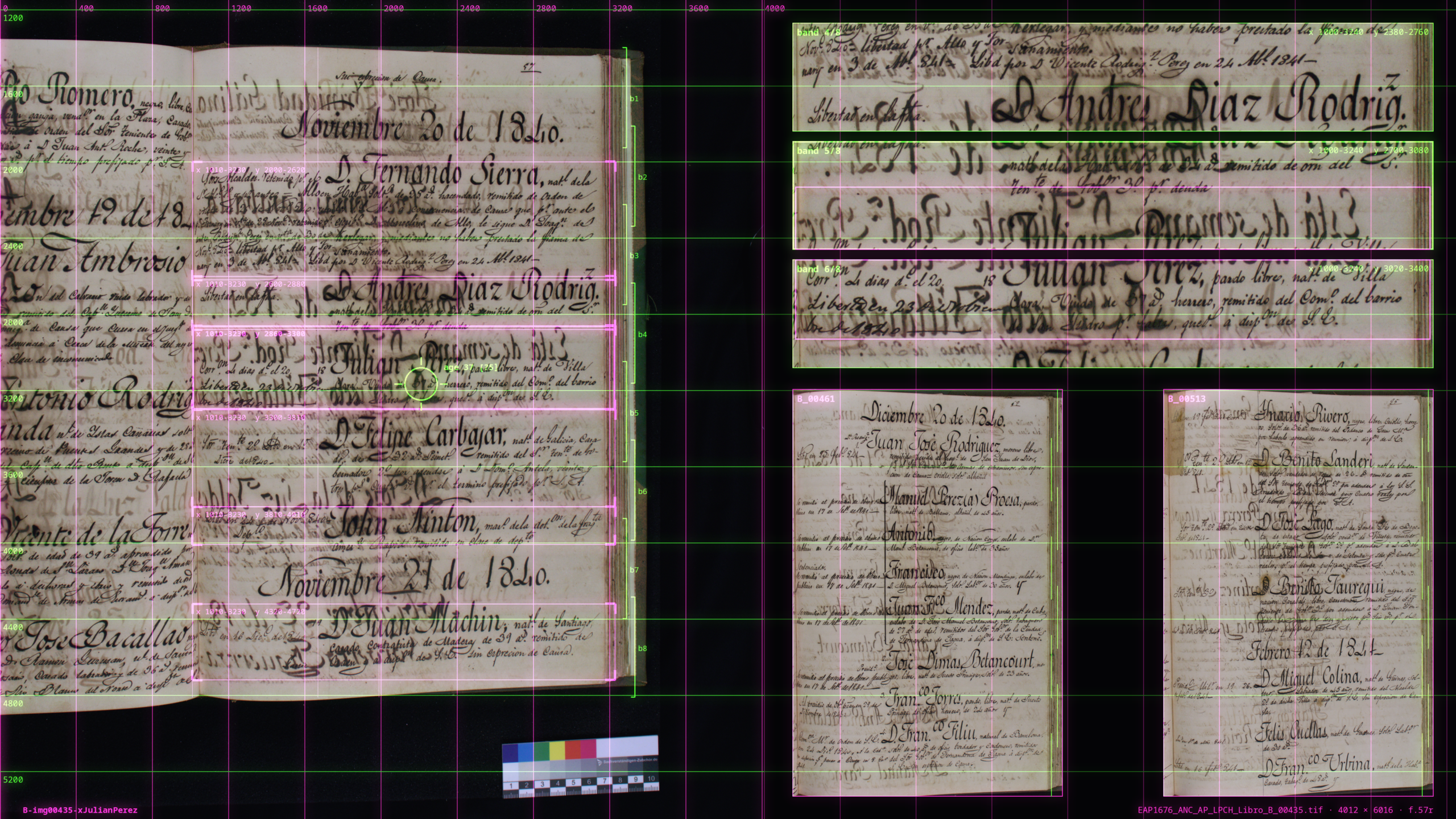
AI-assisted transcription and analysis for documents on the Havana Royal Prison, 1839-1841. From the Prison Blueprint Project.
I did not come to this work as an enthusiast for the technology. I am a historian of slavery and abolition in the Spanish Atlantic, formed between two languages and two historiographies, and my subjects are the people whom empire recorded chiefly in order to control, repress and punish.
The registers list thousands of them: name, age, legal condition, alleged offence, the authority that arrested them, and what became of them. My research concerns lives like that of Candelario Villafaña, a free Black tobacco grower from Santiago de Cuba sentenced in 1836 to two hundred lashes and ten years in the North African enclave of Melilla, a punishment that fused the penal codes of counterrevolution and slavery. Lives of this kind survive mainly in the state’s own ledgers.
AI-assisted transcription made the corpus feasible in challenging circumstances. It did so on one condition, which we have come to call verification by design.
What drew me to generative AI was a practical problem: twelve volumes, tens of thousands of pages, one researcher in Havana and three of us four thousand miles away, in Glasgow. We began in the middle of an economic collapse without precedent, a humanitarian crisis, the drums of war beating in Havana, and a slow-brewing crisis in the UK’s higher education sector: tight budgets, redundancies, ever-increasing workloads. AI-assisted transcription made the corpus feasible in challenging circumstances. It did so on one condition, which we have come to call verification by design: blind double readings of the same page, confidence recorded field by field rather than entry by entry, a categorical distinction between what was read on the page and what was reconstructed from context, and corrections that are documented in sequence rather than silently overwritten. The workflow assumes error and builds the discovery of error into its structure. Substantive judgements, the ones that change what the record is taken to say, remain human decisions, made in dialogue with the colleagues in Havana who know these books better than anyone.
I would rather teach students to use these tools in the way the archive has forced me to, with suspicion, method, and an audit trail.
This September I return from research leave to a full teaching year: a second-year module I convene, lectures on slavery and empire, seminars, dissertation supervision. My students will use these tools. Some already do, with or without permission, and the sector’s occasional posture of pretended abstinence teaches one lesson only: that the tools are shameful and best used in secret. I would rather teach students to use them the way the archive has forced me to, with suspicion, method, and an audit trail. Candour seems the minimum owed to people we are training to care about evidence.
***
Four strategies have travelled from the archive into my classroom
First, make the machine’s failures the object of study.
Give students a digitised document alongside a machine transcription and assess what they catch: the omissions, the mistranscriptions, the silent normalisations of period spelling. This is palaeography and source criticism under another name, and it rewards exactly the slow attention that unstructured AI use erodes. It also inverts the usual anxiety. The question is no longer whether the machine did the student’s work, but whether the student can find where the machine went wrong.
Second, teach provenance as a discipline.
In our database, every value carries its origin: which model, which version, which date, whether a human has verified it. A student essay can carry the same apparatus in miniature. If a tool was used, the submission records what was asked, what was returned, and what the student changed and why. This converts a policing problem into a methodological habit, and it mirrors what we already demand of footnotes. A footnote is, after all, a provenance record.
Third, interrogate the machine’s narrative habits.
When we asked models to draft biographies of the men and women in the registers, the results bent towards a template: adversity, striving, redemption, a hero’s arc that survived every attempt to prompt it away. The registers rarely offer redemption. They offer recidivism, transfer between jurisdictions, fever, and release without comment. The exercise I intend to set is exactly that confrontation: generate the machine’s version of a life, then dismantle it against the documents. Nothing I know of conveys the difference between narrative convention and historical evidence more efficiently, and that is perhaps the central distinction we teach.
Fourth, teach students to say where the reading stops and the reconstruction begins.
A prisoner’s age is on the page; his motive is not. The machine, like an undergraduate under a looming deadline, prefers a confident guess to an admitted blank, and neither flags the difference. In our database, the two live in separate fields, one recording what was read and one what was inferred, with the evidence for the inference attached. A student can do the same in prose, marking each claim as read, inferred, or unknown, and stating what evidence would settle the last of these. That habit of distinguishing degrees of certainty is a skill no tool supplies, and it survives the tool going out of date.
***
Candour also requires saying what these strategies cannot fix. The models we use were not built or tested with Hispanic colonial records in mind, and their biases on this material remain largely unmeasured; establishing them is research still to be done. The archive itself exists as digital images because my colleague Yaimara Izaguirre photographed the volumes, page by page, in conditions that most UK universities would consider impossible. Cuba is living through a humanitarian crisis: power cuts that last days, shortages of food, fuel and medicine, and an exodus that has emptied whole streets.
Every page the model reads exists because a historian in Havana did this work, and any honest account of AI in the humanities has to include the unevenly distributed labour, energy, and access on which these systems rest.
The National Archive of Cuba has had to cut its opening hours to four mornings a week. The camera, the copy stand, the lights and every spare part travelled from Glasgow in our luggage, because none of it can be bought in Havana. The internet connection is too weak and unreliable to transfer the photographic files, so each day’s images go onto an external hard drive, and the drives make their way to Scotland in the luggage of colleagues, friends and acquaintances, an arrangement held together by goodwill and good luck. My colleague Yaimara reaches the archive across a city where public transport has shrunk to a few routes a day, and fares have multiplied. Every page the model reads exists because a historian in Havana did this work, and any honest account of AI in the humanities has to include the unevenly distributed labour, energy, and access on which these systems rest. Above all, the registers document a state that classified people by colour and calibrated punishment accordingly.
To run extraction over such material without an ethical framework would repeat, at speed, something of the archive’s original violence: the reduction of persons to data. Working properly here means partnership rather than use, credit for the colleagues who make the work possible, and frameworks agreed with them rather than exported to them.
Those commitments belong in the classroom, because our students are entering a profession, and a world, in which the temptation to let convenience set the terms will only grow.
In practice, partnership has meant small and unglamorous things. Yaimara’s authorship travels with the images and with the outputs that use them. The transcription conventions were written in Spanish first and translated afterwards, not the other way round. A disputed reading is settled by the people who have handled the books, and the machine’s reading enters the record as one opinion among several, dated and attributed like any other. The cameras, the laptops and the lights will stay at the National Archive of Cuba when the project ends, together with the training that came with them. Those commitments belong in the classroom, because our students are entering a profession, and a world, in which the temptation to let convenience set the terms will only grow.
None of this is free. Here I want to be most direct with colleagues designing their courses for the coming year. Verification-centred assessment takes longer to design and longer to mark than the essay formats it would replace. Provenance requirements need explaining, modelling, and moderating.
Staff need time to learn tools well enough to teach their failures, and workload models have been slower to recognise that time than policy documents have been to demand it. The worst available position is the common one: prohibition on paper, quiet toleration in practice, and the entire burden of judgement pushed onto individual markers. If universities mean what they say about academic integrity, the change has to be resourced, not merely announced.
At a roundtable I am convening for the Royal Historical Society’s visit to Strathclyde this autumn, we have framed the conversation to include colleagues who use generative AI and colleagues who actively reject it on ethical and pedagogical grounds, because both are serious responses to the same question, and the discipline needs the argument between them rather than a premature consensus.
The skills our discipline has taught for generations, unfashionable, slow, and cumulative, turn out to be the operating requirements of an AI-saturated information world.
What I keep returning to, though, is how well prepared historians already are for this moment, and how little of that preparation came from technology. Our training consists in asking of every text who made it, for whom, under what constraints, and what it leaves out. That is precisely the interrogation the machine requires of its readers. The skills our discipline has taught for generations, unfashionable, slow, and cumulative, turn out to be the operating requirements of an AI-saturated information world. We should say so to our students plainly, because it is true, and because it gives them a reason beyond assessment to do the slow, hard, meaningful work.
Somewhere in the Havana Prison Logbooks there is, almost certainly, a marginal note the model has not read: a few words in a clerk’s hand, recording what became of someone the state otherwise reduced to an entry. A student who has learned to notice such silences, in an archive or in a chatbot’s fluent answer, is learning the discipline. That is what I hope to teach in my classroom.
About the Author
Dr Jesús Sanjurjo FRHistS FHEA is Lecturer and Chancellor’s Fellow in Atlantic World History at the University of Strathclyde.
He is a Councillor and Trustee of the Royal Historical Society, and Principal Investigator of ‘The Prison Blueprint Project’ (theprisonblueprint.com), which is digitising and analysing Havana’s Royal Prison Logbooks (1836–1936).
A note on the provenance of this piece.
The second strategy above asks students to declare how a tool was used, and consistency requires me to do the same. I drafted this piece from my own notes. Between August and September 2026, I then used Claude (Anthropic) models Opus 5 and Fable 5 to review the draft for fluency, flag inconsistencies in names and dates for me to check, and to propose two alternative versions of one paragraph. I kept the corrections and one of the two rewrites; I rejected its suggestion that the piece should end two sentences earlier, because the argument needs its landing.
No source, quotation, name or date in this piece came from a model, and none was verified by one. The transcription and analytical work described above have separate, dedicated methodological and ethical guidelines.
