By Alyssa Myers
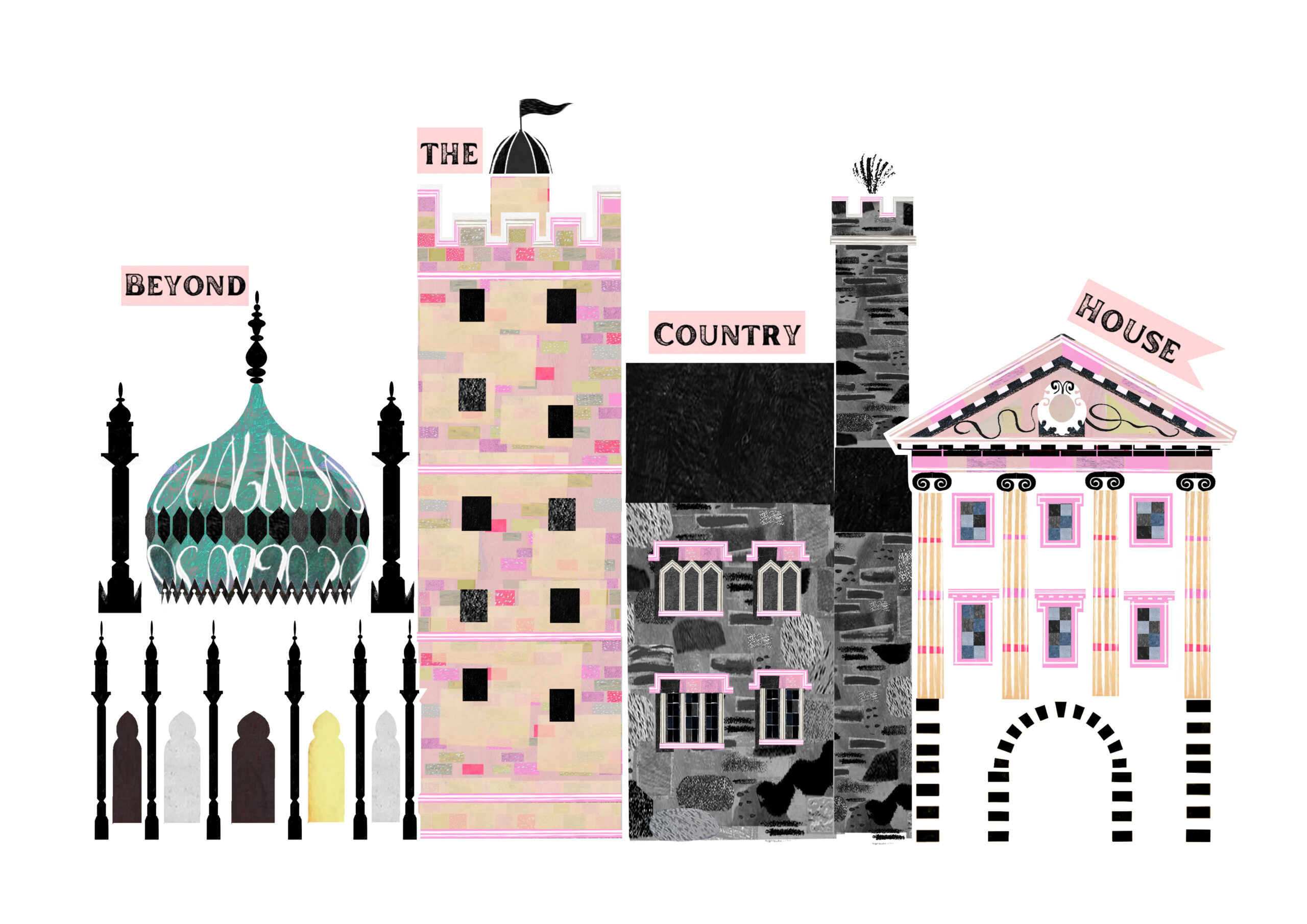
Beyond the Country House is an overarching collaborative research project with English Heritage that will bring together a variety of scholars through two workshops in 2026 and a conference following early 2027. The country house has been a major focus of research for academics and heritage professionals alike in recent years, but what about the houses that do not quite fit under the traditional country house umbrella, such as villas, townhouses, seaside resorts, hunting lodges, royal residences, pleasure palaces? There has been little room for these houses in the historiography beyond their own narrow categorisations or through time-period specific studies. These spaces always existed as part of a larger network of historic houses that often included the country house, and by bringing them back into the scholarly conversation, we can create a better understanding of the ways in which owners designed and lived in their different houses. Beyond the Country House aims to problematise the use of strict definitions and the compulsion to categorise elite residences to create a more inclusive research and interpretation practice.
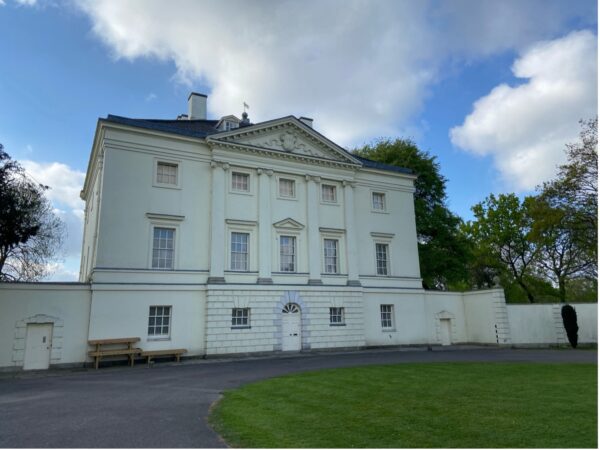
Marble Hill, Twickenham. Photograph author’s own.
On 21 April 2026, we hosted our first workshop, supported by funds from an RHS Workshop Grant, at English Heritage’s Marble Hill in Twickenham, an eighteenth-century suburban London villa, and consisted of sixteen scholars from a variety of disciplines and career stages. The proposed outcome from the first workshop was to begin a conversation to bridge divisions between academic historians and heritage practitioners, to stimulate thinking about the ways in which we choose to define and categorise historic houses both in research at the foundational level through to active interpretation. Speakers through the day included Chris Law (University of Buckingham & RIBA), Tomas Brown (University of Cambridge), Jemima Hubberstey (Historic Royal Palaces), and Abigail Longmate (University of Oxford).
The day started with a quick tour of the house to begin to tie in themes of spaces and categorisations beyond the country house. The aim of the workshop was to create an informal space for conversation and featured five speakers who presented short, ten-minute papers that were each followed with twenty minutes of group discussion. Where this workshop differed, was that instead of the presentations concluding with a speaker Q&A, the speakers were asked to end their talk with a question for the group in which to initiate a discussion around themes presented in their research. The chairs were arranged in a semi-circle format, so everyone could see each other, and speakers were asked to return to their seats for the discussion — thus creating a welcoming and neutral environment to encourage dialogue.
We quickly found that the variety of disciplines and experiences represented in attendees brought out different ways of thinking and questioning, leading to rich discussions around heritage and historic houses more broadly. The conversations following each talk brought out several key points for further reflection, including the advantages of utilising categorisations in historic house studies by connecting groups of like houses over time (through style, for example), and that sometimes arbitrary definitions are necessary to the study of these spaces. On the other hand, the current categorisations used in historic house studies can be exclusionary for spaces on the periphery while also allowing a narrow focus on one house (the country house) but neglecting that owners could have several houses that were all interconnected. There was also a large focus on looking at historic houses as part of a whole estate, beyond just the house itself.
The day ended with a small group session, where everyone was asked to think about parameters for the conference in 2027. This was accomplished by setting the prompt of ‘fill in the blanks’ with three defining buzz words for the title, ‘Beyond the Country House: ___, ___, ___’. This exercise allowed everyone to reflect on the day and put into practice the overall discussions. This led to ideas on how to improve the call for papers and a preliminary conference title of ‘The Country House and Beyond: Spaces, Connections and Perceptions’.
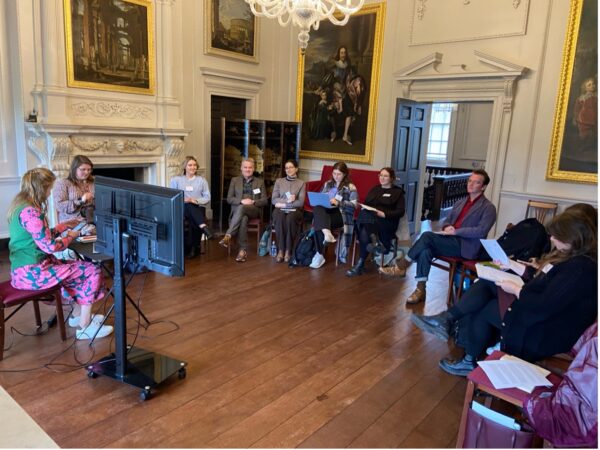
In the Great Room at Marble Hill, listening to speaker Dr. Jemima Hubberstey. Photograph author’s own.
The conversations from the first workshop will be further explored with a focus on research and interpretation more specifically at the second workshop on 3 November 2026, at Bolsover Castle. We found that for the first workshop with Marble Hill being a Palladian villa, conversations gravitated towards style and houses such as villas and other intermediary spaces, namely barns, follies and gardens. With this, it is expected that Bolsover as a castle will facilitate more discussion around royal residences and larger country houses that had multiple uses throughout their history. The conference to follow on 7 April 2027 at Manchester Metropolitan University will showcase the conversations had in both workshops and formulate strategies for creating more impactful and lasting change as well as a general awareness of how we understand historic houses across disciplines.
About the author
Alyssa Myers is a 3rd year AHRC funded collaborative PhD researcher with Manchester Metropolitan University and English Heritage. Her thesis examines the forms, functions and networks of the eighteenth-century suburban London villa.
Featured Image credit: Illustration courtesy of Dr Bethan Scorey. https://bethanscorey.bigcartel.com/
